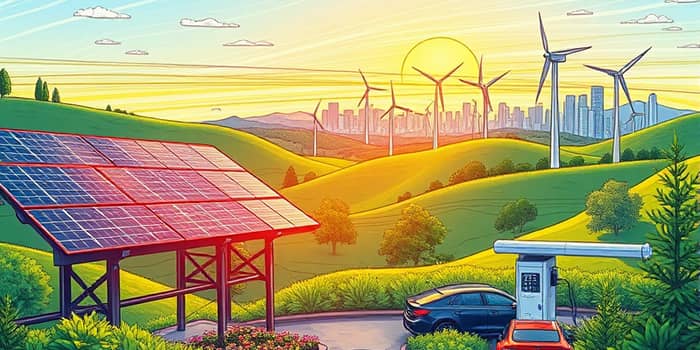
The world stands at a critical crossroads as climate change accelerates and traditional energy sources strain under rising demand. Across continents, nations are pivoting toward sustainable power solutions that promise not only environmental resilience but also economic revitalization. In this comprehensive exploration, we delve into the forces driving the renewable energy revolution, unveil actionable insights, and celebrate the pioneers shaping a cleaner, more equitable future.
From a valuation of roughly $800 billion in 2019 to an estimated $1.4–1.5 trillion in 2025, the renewable energy sector has achieved an unprecedented global growth trajectory. A compound annual growth rate of 12–15% between 2019 and 2024 has outpaced many traditional industries, signaling a profound shift in where capital flows and where jobs are created.
In 2024 alone, the industry set a new record with record-breaking 15.1% capacity growth, driven primarily by a surge in solar installations. Over three-quarters of new renewable capacity stemmed from photovoltaic systems, reflecting both technological advances and a cascade of supportive policies from national and local governments.
Solar energy commands roughly 42% of the global renewable market, with annual revenues between $420 and $500 billion in 2024. Costs for photovoltaic modules have plummeted by over 70% in the past decade, making rooftop and utility-scale solar projects more accessible than ever. Meanwhile, China’s addition of 277 GW of solar capacity last year underscores how manufacturing scale and innovation can drive down prices and accelerate deployment.
Wind energy follows closely, accounting for about 25–30% of the sector. Onshore turbines dominate 80% of that share, while offshore wind farms are rapidly expanding in regions like Europe and East Asia. In 2024, combined solar and wind output surpassed coal-fired generation in the United States for the first time, demonstrating how renewables are reshaping the electricity mix.
The global market is unevenly distributed, creating distinct opportunities and challenges across regions. Asia-Pacific leads with a 55% share, propelled by China’s early achievement of its 2030 targets and India’s ambitious green hydrogen roadmap. North America and Europe each hold about a fifth of the market, supported by policy incentives, corporate commitments, and emerging clean energy clusters.
Renewable energy is not solely the domain of large utilities. Household rooftop solar, community wind co-ops, and virtual power plants are democratizing power generation. Homeowners can sell excess electricity back to the grid, while small businesses reduce overhead by integrating on-site renewables and battery storage.
By adopting rapidly evolving energy landscape strategies, communities can achieve energy independence, lower bills, and foster local job growth. Schools, hospitals, and small manufacturers integrating renewables can serve as shining examples of sustainable development.
With COP28 commitments aiming to triple global renewable capacity to over 11,000 GW by 2030, the investment horizon has never been clearer. Meeting this goal demands $4.5–5.5 trillion in infrastructure spending and annual additions exceeding 950 GW. For investors, this represents a monumental opportunity to deploy capital into transformative projects that deliver both financial returns and social impact.
Institutional investors, venture funds, and impact philanthropies can play pivotal roles by targeting:
By focusing on strategic investment in clean infrastructure, financiers can help bridge funding gaps, de-risk early-stage technologies, and accelerate global decarbonization efforts.
Despite robust momentum, the renewable sector faces headwinds—from supply chain disruptions and raw material price swings to policy uncertainty in key markets. Grid integration remains complex, requiring coordinated upgrades and advanced forecasting tools to manage variable output.
To surmount these hurdles, stakeholders must pursue coordinated policy support and innovation by:
The narrative of renewable energy is one of bold ambition and collective action. From rural villages deploying solar microgrids to megacities overhauling their entire energy systems, the transition is already reshaping economies and empowering citizens.
As individuals, businesses, and governments rally around cleaner power, every panel installed and every turbine spun becomes a testament to human ingenuity and determination. By embracing practical solutions, investing wisely, and fostering collaboration, we can ensure that the coming decades are defined not by scarcity and pollution, but by abundance, equity, and hope.
Together, we are not just fueling the energy grid of tomorrow—we are igniting a brighter future for generations to come.
References