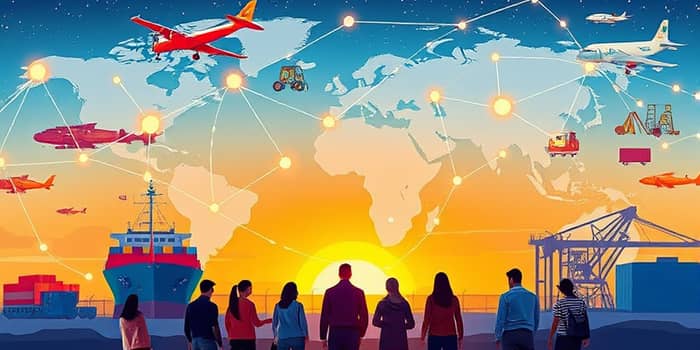
In an era defined by uncertainty, global businesses face ever-shifting challenges that test the very foundations of how goods flow across borders. Developing ability to persist, adapt, or transform under pressure is no longer optional—it is essential for survival.
The COVID-19 pandemic revealed vulnerabilities in the intricate web of international commerce. As factories shuttered and ports fell silent, organizations realized they needed more than contingency plans—they needed true endurance. Revenues plunged, costs soared and customers grew weary of delays. Yet, from the chaos emerged a powerful lesson: resilience is the new currency of trust.
Beyond the pandemic, other threats have surfaced, underscoring the need for robust defenses. These include:
Understanding these risks is the first step toward building systems capable of withstanding shocks and thriving in their aftermath.
Recent statistics paint a clear picture of mounting pressures. In 2024, a staggering 80% of organizations confronted supply chain breakdowns, many multiple times within the year. Asset engineering investments surged as 41% of firms sought to bolster their defenses against extreme weather events. Tariff volatility further complicated planning, with the Global Supply Chain Pressure Index reaching 0.19 in May 2025, signaling above-average stress.
Contract manufacturers responded by stockpiling inventory—approximately 30% increased their holdings—while flatbed trucking rates climbed 4.5% year-over-year. These tactical moves provided short-term relief but also tied up capital and warehouse space.
At the macro level, economists predict softer growth. According to the World Economic Forum, 56% of leading chief economists expect weaker global conditions in 2025. Navigating this landscape requires innovative strategies that go beyond traditional cost cutting.
Resilient supply chains rest on four foundational pillars. Each supports a distinct capability and together they create a cohesive defense.
Implementing these pillars requires modern tools and disciplined processes. Leading organizations deploy AI-driven demand forecasting tools to anticipate shifts in consumer behavior and optimize inventory levels. They leverage Multi-tier supply chain visibility platforms that map beyond first-tier suppliers, offering predictive alerts when disruptions loom.
Equally important is fostering open, transparent relationships with vendors. By sharing forecasts and performance metrics, partners can align production schedules, avoid stockouts and jointly develop mitigation plans.
The post-pandemic era saw many companies adopt a “resilience at all costs” mindset, adding redundancies and reshoring production. While these measures enhanced security, they also strained budgets. High inventory levels led to increased carrying costs, and duplication of facilities reduced economies of scale. Soon, boards demanded a recalibration of priorities.
The emerging “cost of resilience” approach strives for equilibrium between agility and affordability. Key strategies include:
By targeting resilience investments where they yield the highest risk mitigation per dollar spent, businesses can maintain competitiveness while safeguarding operations.
To forge truly resilient supply chains, companies and governments must collaborate. Policymakers play a vital role by crafting agile regulations and discouraging shortsighted trade barriers. At the same time, private enterprises must embrace continuous improvement, periodically stress-testing their networks against simulated disruptions.
Key actions for executives include setting clear performance metrics, prioritizing transparency and investing in talent capable of interpreting complex data landscapes. Cultivating a culture that values anticipation over reaction ensures that resilience becomes ingrained, not an afterthought.
Ultimately, supply chain resilience is more than a technical achievement—it is a testament to human ingenuity and collaboration. In weaving stronger, more adaptable networks, we not only protect the flow of goods but also preserve livelihoods, support economic stability and foster global solidarity. Every delay avoided, every risk neutralized and every innovation adopted brings us closer to a future where disruption is met not with panic, but with purpose.
References