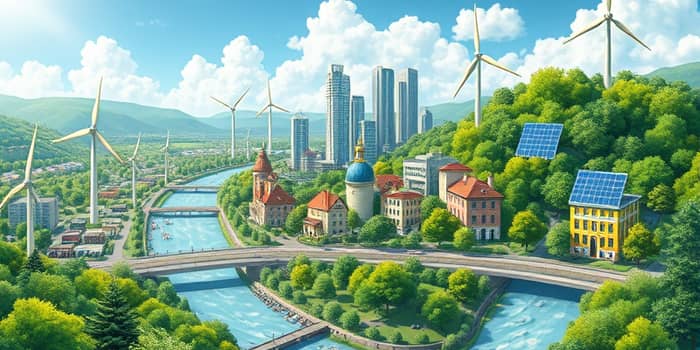
As the world races to decarbonize, investors stand at the crossroads of environmental stewardship and financial returns. The carbon economy, once a niche concept, has grown into a multi-trillion-dollar arena offering unprecedented opportunities. This article explores the landscape, from market projections to investment vehicles, empowering you with insights and practical strategies.
In recent years, we’ve witnessed explosive growth in carbon credits. In 2024, the global market valuation reached USD 633.87 billion; by 2025, it soared to USD 933.23 billion. Projections estimate an astonishing rise to between USD 10.55 trillion and USD 16.38 trillion by 2034, driven by compound annual growth rates of 32.5% to 37.7%. This remarkable expansion in value underscores the depth of investor interest and regulatory momentum.
Beyond carbon credits, the broader green economy is flourishing. Valued at US$7.9 trillion in early 2025, it represents 8.6% of listed equity markets and has grown at a 15% CAGR over the past decade. As technology, policy, and capital converge, the stage is set for continued innovation.
The carbon market is structured into compliance and voluntary segments. In 2025, compliance mechanisms accounted for over 98% of revenue, underpinned by schemes like the EU Emissions Trading System (ETS) and China’s national carbon market. Meanwhile, the voluntary carbon market, which peaked at $2 billion in 2021 but contracted to $535 million in 2024, is poised for a rebound to $10–25 billion by 2030.
Revenue is further distributed across project types and end uses. Avoidance/reduction projects—such as renewable energy deployment and deforestation prevention—generated over 67% of revenue in 2025. The power sector alone claimed a 32% share, illustrating the critical role of utilities in decarbonization.
Geography shapes opportunity. Europe leads in revenue share, bolstered by a mature ETS and rising carbon prices. The Asia-Pacific region, particularly China, South Korea, and Australia, is outpacing peers with new trading schemes. North America is projected to register the fastest growth, driven by corporate net-zero pledges and state-level initiatives.
Several factors are fueling this progress:
Investors can access the carbon economy through a spectrum of instruments. Green bonds, which reached a record issuance of US$572 billion in 2024 and $700 billion overall that year, fund projects from wind farms to sustainable urban development. Green equities and ETFs, covering over US$5.1 trillion in market cap, allow diversified exposure to companies leading the energy transition.
The Inflation Reduction Act in the U.S. earmarked $369 billion for climate solutions, propelling investments in clean energy technologies. Solar panel costs have plummeted, and battery storage is more efficient, further enhancing project viability.
To navigate this dynamic environment, consider these strategic imperatives:
Here is a snapshot of projected carbon credit supply and costs:
As the carbon economy matures, action and adaptability are paramount. Here are practical steps for investors:
Remember, the transition to a low-carbon world is not just a moral imperative but a financial revolution. By aligning capital with sustainability, investors can drive transformative change and reap long-term rewards.
The carbon economy offers a pathway to decouple economic growth from emissions. With careful strategy, robust partnerships, and a commitment to integrity, you can position your portfolio at the forefront of this emerging markets leapfrogging old models, shaping a prosperous and resilient future for generations to come.
References