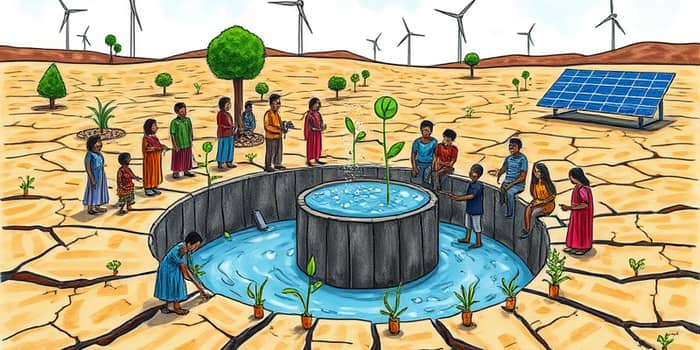
We stand at a crossroads where the world’s most vital element is slipping through our fingers. Every drop counts as we confront an unprecedented freshwater crisis that touches every continent and community.
Understanding both the scale of the challenge and the promise of bold action is essential. This article explores the forces driving scarcity, the profound human and economic toll, and the innovative financing models that can turn crisis into opportunity.
Today, the planet loses 324 billion cubic meters of freshwater each year—enough to meet the annual needs of 280 million people. By 2025, 1.8 billion people live in regions plagued by scarcity, while two-thirds of humanity endures water-stressed regions.
Safe drinking water remains a luxury for many. Over 2.2 billion people lack properly managed supplies and 4.5 billion lack safe sanitation. Every two minutes, a child dies from a water-related disease. Vulnerable populations in Africa, Asia and the Middle East face the harshest reality: long treks for contaminated sources, lost school days, and shattered opportunities.
The roots of scarcity run deep, from policy failures to environmental stress:
Certain regions bear the brunt of this crisis, where per capita availability has plummeted and infrastructure is failing:
Water scarcity is not an abstract risk—it has tangible costs that ripple through families, industries, and economies. Every year, $260 billion is lost due to lack of basic water and sanitation, hindering productivity and deepening inequality.
In India, cooling shortages at thermal power plants resulted in 8.2 terawatt-hours of lost electricity between 2017 and 2021—enough to power 1.5 million homes for five years. Globally, up to 31% of GDP ($70 trillion) will face high water stress by 2050.
Amid crisis, opportunity emerges. A three-part strategy can guide action:
Virtual water trade has saved 475 billion cubic meters annually since 2010. Smart investments in infrastructure—notably decentralized treatment plants and leak detection—are unlocking meaningful change at scale.
Innovative financing models, from blended public-private funds to green bonds, are channeling capital into regions of greatest need. Policymakers now harness unprecedented data to pinpoint hotspots and tailor interventions, making every dollar count.
Every individual, organization and government holds a piece of the solution. By supporting water-efficient appliances, choosing sustainably produced foods, and advocating for smart policies, we can drive collective impact.
Community-led conservation projects, corporate water stewardship programs, and philanthropic partnerships all play a role. Remember: a collective effort can preserve this critical resource for generations to come.
As demand is set to exceed sustainable supply by 40% by 2030, the time to invest is now. Together, we can turn scarcity into security and build a future where water flows freely and equitably for all.
References