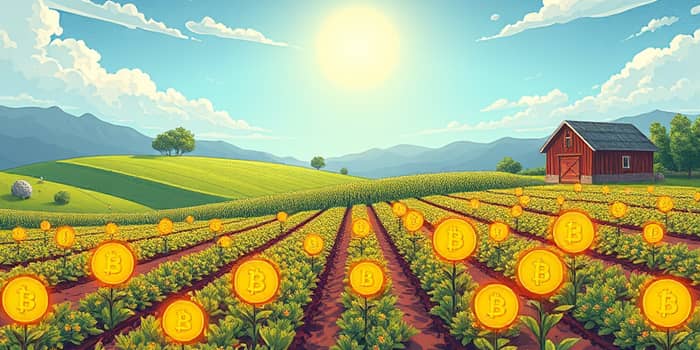
In the evolving landscape of decentralized finance, yield farming has emerged as a powerful method for moving cryptocurrency assets across platforms to secure superior returns. By strategically deploying idle tokens into various protocols, participants can tap into a dynamic ecosystem where liquidity and reward opportunities intersect.
While this practice promises generate additional returns or rewards far beyond traditional finance, it also demands a deep understanding of underlying mechanisms and awareness of potential pitfalls. This guide explores every facet of yield farming, offering actionable insights to both novices and seasoned DeFi enthusiasts.
At its core, yield farming revolves around providing liquidity to decentralized applications in exchange for fees and native tokens. Participants stake or lend assets into smart contracts known as liquidity pools, earning a share of transaction fees and protocol incentives. This process hinges on several essential building blocks.
When you deposit assets, you receive LP tokens representing your stake. These tokens track your proportional ownership and entitle you to a share of the pool’s earnings. Understanding LP tokens is critical before venturing into any yield farming strategy.
Yield farming protocols charge small fees on each trade or lending transaction within their pools. These fees accumulate and are distributed among LP token holders based on their contribution size. Over time, rewards compound as users reinvest earnings back into the pool.
By leveraging staking or lending crypto assets across multiple platforms, farmers can optimize returns and capture high yields. Some protocols even mint governance tokens to incentivize early adopters, adding further upside potential for strategic participants.
Yield farmers employ a variety of methods to maximize profit and manage risk. Tailoring your approach to current market conditions and personal risk tolerance is essential for long-term success.
Similar to agricultural practices, yield farmers practice “crop rotation” by shifting funds between protocols when more lucrative opportunities arise. This approach demands constant monitoring of APY rates, token values, and protocol health to stay ahead of market shifts.
Seasoned farmers often hop between protocols like Compound, Curve, Synthetix, Uniswap and Balancer, optimizing positions to chase the best returns. Migrating capital efficiently while minimizing transaction fees is a hallmark of a successful rotation strategy.
Despite its allure, yield farming is not without hazards. Participants must stay vigilant against a spectrum of threats that can erode gains or lead to outright losses.
Market swings and inherent volatility and market fluctuations can drastically reduce asset values. Impermanent loss occurs when asset ratios in a pool diverge significantly, leaving providers worse off than if they simply HODLed their tokens.
Smart contract code may harbor bugs or backdoors, exposing funds to smart contract vulnerabilities and exploits. New or unaudited projects can be outright scams, promising unsustainable returns and disappearing overnight. Regulatory crackdowns can also freeze or ban operations, underscoring the importance of compliance awareness.
Prudent farmers employ several safeguards to protect their capital and sustain long-term profitability. No single tactic eliminates risk entirely, but a layered approach can significantly reduce exposure.
As DeFi matures, yield aggregators and automated vaults will continue to simplify access, offering automatic yield compounding through reinvestment and optimized gas usage. Advanced algorithms will rebalance strategies in real time, delivering efficiency to everyday users.
Protocol developers are exploring cross-chain integrations and layer-2 scaling solutions, aiming to reduce costs and unlock new liquidity sources. These innovations promise to make yield farming more accessible, scalable, and secure.
Ultimately, yield farming represents a frontier where unlocking DeFi’s full potential responsibly can transform passive holdings into dynamic income streams. By educating themselves, leveraging automation, and managing risks diligently, investors can cultivate a robust DeFi portfolio capable of weathering market cycles and delivering sustained growth.
References